
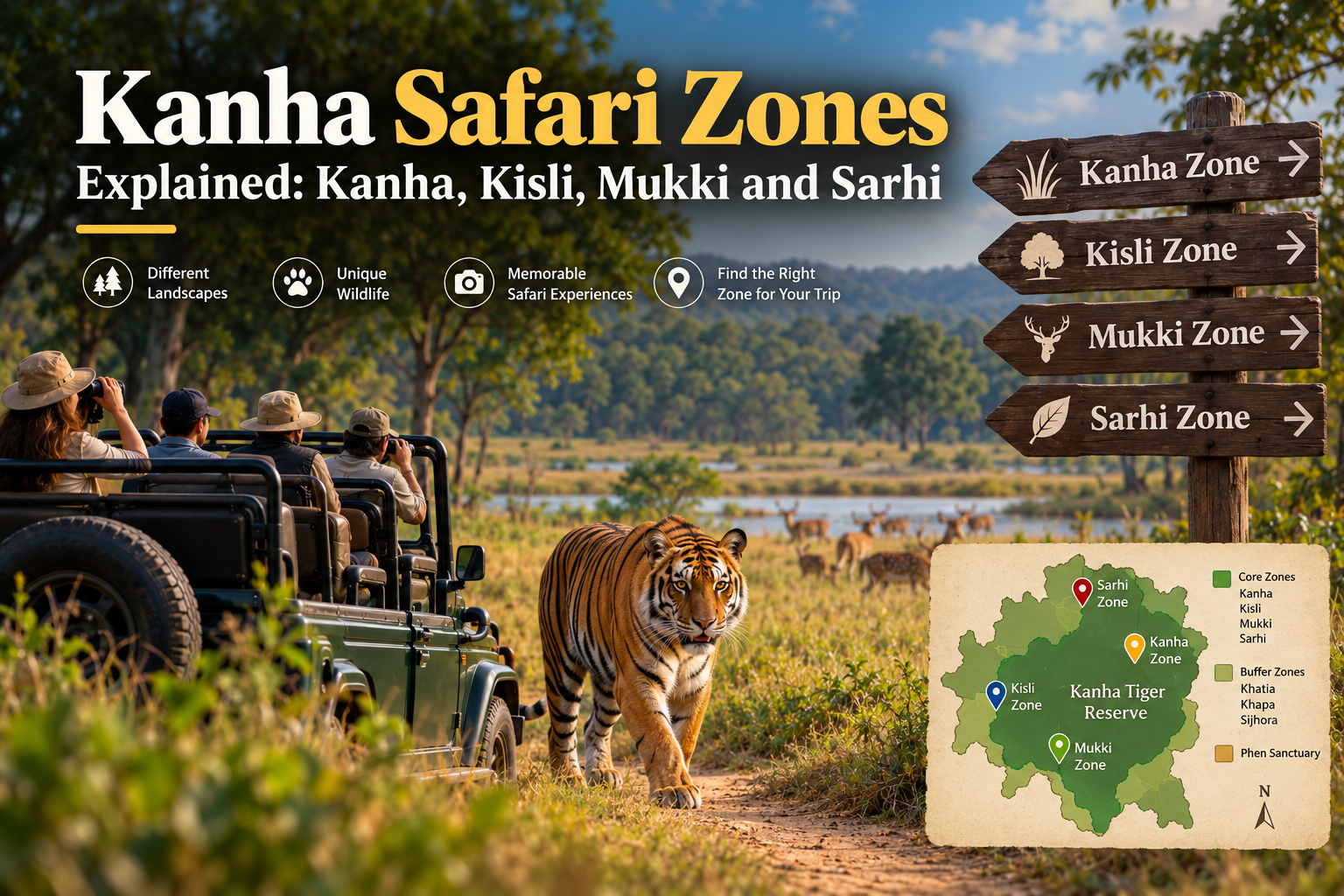
Kanha Safari Zones Explained: Kanha, Kisli, Mukki and Sarhi
If you are planning a wildlife trip to Kanha National Park, one of the first questions you may have is: Which safari zone should I book?
The four main Kanha safari zones are Kanha, Kisli, Mukki, and Sarhi. All four are located within the core area of Kanha Tiger Reserve, but each offers a slightly different safari experience, entry arrangement,t and landscape.
Kanha Tiger Reserve currently has four main core tourism zones: Kanha, Kisli, Mukki, and Sarhi, along with buffer tourism areas and Phen Sanctuary.
This guide explains the difference between the four core zones, which entry gates are used, how buffer zones work,rk and how to choose the right zone for your trip.
If you are still planning your overall wildlife holiday, first explore our complete Kanha National Park guide for information about the park, wildlife, season, and travel planning.
Quick Answer: Which Are the Main Kanha Safari Zones?
The four main core safari zones are:
| Safari Zone | Area of Reserve | Main Character |
|---|---|---|
| Kanha Zone | Central Kanha | Meadows, forest, and classic Kanha scenery |
| Kisli Zone | Western section | Sal forest and varied habitat |
| Mukki Zone | Southern section | Dense forest, grasslands, and wildlife viewing |
| Sarhi Zone | Northern section | Quieter forest landscapes and mixed habitat |
The reserve also includes buffer tourism zones such as Khatia, Khapa and Sijhora, while Phen Sanctuary forms another tourism area associated with the reserve.
Before selecting a zone, check current permits, safari sessions,s and booking requirements through our Kanha Safari Booking page.
What Is the Kanha Core Zone?
A core zone is the more strictly protected part of a tiger reserve where wildlife conservation remains the primary priority.
Kanha Tiger Reserve includes both core and buffer landscapes, with tourism controlled through designated routes and safari permits.
Tourism inside the core is managed through:
-
Limited safari permits
-
Fixed safari routes
-
Registered safari vehicles
-
Designated entry gates
-
Regulated morning and evening safari sessions
The four main core tourism zones are Kanha, Kisli, Mukki and Sarhi.
1. Kanha Zone
The Kanha Zone is the central part of the tourism area and is often the zone first-time visitors hear about.
It represents much of the landscape commonly associated with Kanha, including open grasslands, sal forests and broad wildlife-viewing areas.
What Is Special About Kanha Zone?
Visitors may experience a mixture of:
-
Open meadows
-
Sal forests
-
Forest edges
-
Deer habitat
-
Gaur and other mammals
-
Birdlife
-
Potential tiger and leopard movement
Kanha Tiger Reserve is particularly important for the conservation of the hard-ground barasingha. The wider reserve also supports tiger, leopard, dhole, bear, gaur and many other species.
For a broader overview of the reserve's wildlife and natural landscape, read our Kanha National Park guide.
Which Gate Can Be Used for Kanha Zone?
Access arrangements can involve Khatia, Mukki or Sarhi, depending on the safari session, permit and current forest rules.
There may also be restrictions on particular gate-to-zone combinations.
Always confirm the gate printed on your safari permit rather than assuming you can enter from any gate.
If you have not booked your permit yet, check our Kanha Safari Booking guide before finalising your stay.
2. Kisli Zone
Kisli Zone lies in the western part of Kanha's core tourism area.
It is a good choice for travellers interested in a classic forest safari experience rather than choosing a zone only on the basis of recent tiger sightings.
What Can You Expect in Kisli?
Kisli includes a combination of:
-
Sal woodland
-
Forest tracks
-
Meadow edges
-
Mixed vegetation
-
Deer and gaur habitat
-
Birdwatching opportunities
Like every Kanha zone, wildlife movement changes continuously.
A tiger seen frequently in Kisli for several days may later move into another section of the reserve, so sightings can never be guaranteed.
Which Gate Is Used for Kisli Zone?
Gate arrangements depend on the permit and safari session.
This is why your accommodation should ideally be selected after your safari zone and entry gate are confirmed.
Travellers who want safari, stay, ay and transfers planned together can also explore our Kanha Tour Packages.
3. Mukki Zone
The Mukki Zone covers the southern portion of Kanha's core tourism area.
Mukki is particularly convenient for travellers staying on the Mukki side of the reserve.
What Is Mukki Zone Known For?
The landscape may include:
-
Dense woodland
-
Open grassy areas
-
Natural water sources
-
Forest roads
-
Wildlife-rich edges between forest and meadow
You may encounter species including barasingha, spotted deer, gaur, wild boar, and numerous birds, along with the possibility of larger predators.
Which Gate Is Best for Mukki Zone?
Mukki Gate is the most natural access point for travellers staying on this side of Kanha.
If you already have a Mukki Zone permit, choosing accommodation close to Mukki can reduce the amount of early-morning travel required before your safari.
Before deciding where to stay, compare accommodation options and seasonal pricing through our Kanha Resort Tariff page.
4. Sarhi Zone
Sarhi Zone is the northern core tourism zone.
For travellers who want to experience another side of Kanha beyond the most familiar safari routes, Sarhi can be a worthwhile option.
What Can You Experience in Sarhi?
The zone may offer:
-
Mixed forest
-
Open patches
-
Less familiar safari landscapes
-
Birdwatching
-
Herbivore sightings
-
Predator movement depending on current wildlife activity
Sarhi should not automatically be treated as a second-choice zone simply because some visitors are more familiar with Kanha or Mukki.
Wild animals move freely across the reserve and do not remain inside tourism-zone boundaries.
Which Gate Serves Sarhi Zone?
Sarhi Gate is the primary gateway for this section of Kanha.
However, exact entry arrangements can depend on your confirmed permit.
Always verify the zone, gate, and reporting details before leaving your resort.
Kanha vs Kisli vs Mukki vs Sarhi: Which Zone Is Best?
There is no single best zone in Kanha for every visitor.
A practical comparison is:
| Zone | Best For |
|---|---|
| Kanha | First-time visitors wanting classic Kanha landscapes |
| Kisli | Dense forest and varied habitat |
| Mukki | Travellers staying on the Mukki side |
| Sarhi | Travellers interested in exploring the northern section |
Do not select a safari zone only because someone recently saw a tiger there.
Tiger movements can change from day to day.
A better approach is to consider:
-
Permit availability
-
Resort location
-
Entry gate
-
Number of safaris planned
-
Travel time to the gate
If possible, booking safaris in more than one zone can provide a broader experience of Kanha National Park.
What Are the Kanha Buffer Zones?
Kanha is not limited to the four core tourism zones.
The wider tourism structure also includes buffer areas.
Khatia Buffer Zone
Khatia is associated with Khatia Gate, one of the major tourism access points for Kanha.
Khapa Buffer Zone
Khapa is another buffer tourism area associated with the Mukki side of the reserve.
Sijhora Buffer Zone
Sijhora lies toward the Sarhi side of the reserve.
Phen Sanctuary is also associated with the wider Kanha tourism landscape.
Are Buffer Zones Worth Visiting?
Yes.
A common mistake is assuming that only the core area contains wildlife.
Buffer forests remain connected to the wider ecosystem, and wildlife can move between different parts of the reserve.
A buffer safari can be useful when:
-
Core permits are sold out
-
You want an additional safari
-
You want to explore another landscape
-
You are staying near a corresponding buffer gate
If your preferred core safari is unavailable, check alternative permits through our Kanha Safari Booking page before changing your entire trip.
Core and buffer experiences should not be compared purely by tiger sightings.
Every safari is unpredictable.
How Do Kanha Entry Gates Work?
Kanha Tiger Reserve has three main tourism entry points:
-
Khatia Gate
-
Mukki Gate
-
Sarhi Gate
Your safari permit determines the applicable zone and entry arrangement.
Khatia Gate
Khatia is commonly used by travellers approaching Kanha from the Mandla and Jabalpur side.
Many accommodation options are also available around this tourism belt.
Mukki Gate
Mukki can be convenient for travellers arriving from the Balaghat or Raipur side and for visitors staying around Mukki.
Sarhi Gate
Sarhi serves the northern side of the reserve and may be convenient depending on your travel route and booked safari zone.
When comparing accommodation near different gates, review the current Kanha Resort Tariff before confirming your room.
Should You Choose the Safari Zone Before the Resort?
Ideally, yes.
During busy travel periods, one common mistake is:
Book resort → book transport → try to find safari permit
A more practical sequence is:
Check safari permit → confirm zone and gate → choose resort → arrange transfers
For example, if you book accommodation near Mukki but receive a permit requiring entry from another part of the reserve, you could face unnecessary early-morning travel.
For this reason, start with the Kanha Safari Booking page and then select accommodation according to your confirmed safari plan.
How Many Kanha Safari Zones Should You Visit?
If you are staying for only two nights, one or two safaris may be enough to experience the forest.
For a three- or four-night wildlife trip, consider visiting two different safari zones if permits are available.
This can give you:
-
Different forest scenery
-
Different safari routes
-
More wildlife opportunities
-
Morning and evening safari experiences
-
A better understanding of Kanha's landscape
Travellers planning a longer stay can explore Kanha Tour Packages to combine accommodation, safari planning and local travel more conveniently.
Remember that additional safaris increase your opportunities to explore the reserve, but they never guarantee a tiger sighting.
Final Takeaway
The four main Kanha safari zones Kanha, Kisli, Mukki, and Sarhi are all part of the core tourism area, and each can provide a rewarding wildlife experience.
Kanha is known for its central landscapes, Kisli offers classic woodland, Mukki is practical for travellers staying on the southern side, and Sarhi provides another distinctive section of the reserve.
There is no permanently "best" tiger zone.
Instead of chasing recent sighting reports, choose your zone based on permit availability, entry gate, resort location,n and the number of safaris you plan to take.
For current safari planning, visit our Kanha Safari Booking guide. You can also explore our Kanha National Park guide, compare Kanha Tour Packages and check the latest Kanha Resort Tariff before finalising your trip.
Frequently Asked Questions
1. How many safari zones are there in Kanha?
The main core tourism zones are Kanha, Kisli, Mukki and Sarhi. Kanha also has buffer tourism areas including Khatia, Khapa and Sijhora, along with Phen Sanctuary.
2. Which is the best safari zone in Kanha?
There is no permanently best zone. Kanha, Kisli, Mukki, and Sarhi can all provide rewarding wildlife experiences. Choose according to permit availability, gate location, accommodation, and your overall itinerary.
3. Which are the core zones of Kanha National Park?
The four main core tourism zones are Kanha, Kisli, Mukki, and Sarhi.
4. Can I enter any Kanha zone from any gate?
Not necessarily. Gate access depends on your selected zone, safari session, and current permit rules. Always follow the gate and reporting information mentioned on your confirmed permit.
5. Are Kanha buffer zones good for safari?
Yes. Buffer forests are part of the wider wildlife landscape, and animals can move between core and buffer areas. A buffer safari can be a useful option when core permits are unavailable or when you want to explore more of Kanha.